
Solidigm Ships D7-PS1010 and D7-PS1030 PCIe 5.0 SSDs, Turning a New Page for AI-Era Storage
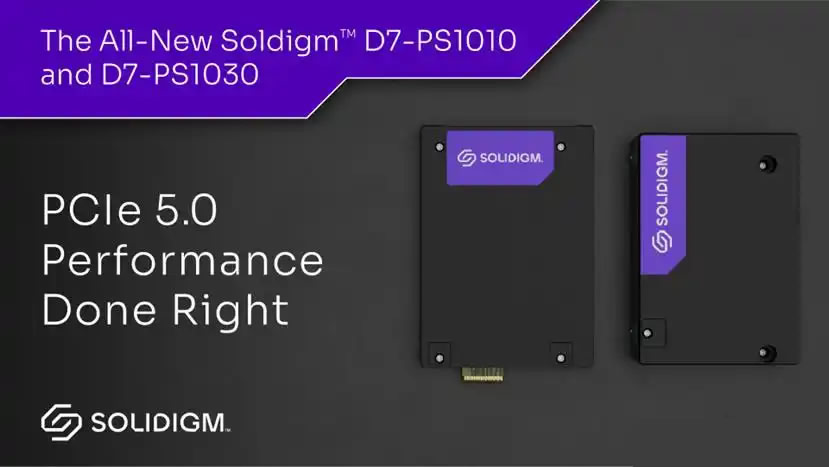
Solidigm's newest data center drives pair PCIe 5.0 bandwidth with up to 70% better power efficiency, targeting general-purpose servers, write-heavy workloads and every stage of the AI data pipeline.
A PCIe 5.0 Refresh Aimed Squarely at AI Infrastructure
As AI training and inference push underlying I/O requirements to levels the industry has never faced before, Solidigm — a global leader in NAND flash storage solutions — has confirmed that two new data center SSDs, the Solidigm D7-PS1010 and Solidigm D7-PS1030, are now shipping in volume. Built on the PCIe 5.0 interface, both drives are designed for today's general-purpose servers, mixed workloads and the punishing write-dominant I/O profiles that increasingly define modern data centers, adding fresh momentum to storage infrastructure built for the AI era.
PCIe 5.0 Bandwidth, Up to 70% Better Power Efficiency
Positioning the two products, Greg Matson, Vice President of Strategic Planning and Marketing at Solidigm, noted that the drives were conceived from day one to address the escalating I/O demands of several workload families at once: general-purpose servers, online transaction processing (OLTP), server-side storage, decision support systems, and artificial intelligence (AI) and machine learning (ML) workloads.
Against a backdrop of mounting energy pressure across the industry, the PCIe 5.0 interface underpins what the company describes as industry-leading "four-corner performance." Measured against comparable SSDs, power efficiency improves by as much as 70%.
D7-PS1010: A Balanced Choice for Mainstream Workloads
The Solidigm D7-PS1010 is positioned as a standard-endurance (SE) SSD and is offered in four capacities: 1.92TB, 3.84TB, 7.68TB and 15.36TB.
- Endurance: A rating of one drive write per day (1 DWPD) over a five-year warranty period, backed by strong program/erase cycle behavior. The 15.36TB model carries a total written endurance of 28 PBW.
- Performance: In server-based storage deployments, sequential write throughput can reach up to 37% higher than that of comparable industry products.
That blend of performance and capacity makes the D7-PS1010 a natural fit for a broad range of mainstream applications.
D7-PS1030: High Endurance Built for Write-Intensive Duty
The Solidigm D7-PS1030, by contrast, is a mid-endurance (ME) SSD available in 1.6TB, 3.2TB, 6.4TB and 12.8TB capacities. The 12.8TB model delivers a write endurance of up to 70 PBW. Against the previous generation of Solidigm SSDs, write performance has doubled — a gain that makes the drive particularly well suited to write-stress-heavy roles such as cache and checkpointing.
When deployed in the all-flash performance tier of an AI workload, the D7-PS1030 also compensates effectively for the inherent limitations of traditional hard disk drives (HDDs) in performance, endurance and reliability.
End-to-End Support for the AI Data Pipeline
Across every stage of the AI data pipeline — from data ingestion and preprocessing through to training and inference — the two SSDs perform strongly, delivering up to 50% higher throughput than comparable products in certain stages. In terms of deployment, they can serve as direct-attached cache drives inside GPU servers, or act as accelerators for slower HDDs within an all-flash high-performance tier.
Ace Stryker, Director of Market Development at Solidigm, argues that as AI workloads explode in scale, storage performance has moved from backstage to center stage, becoming a decisive variable in overall efficiency. In that light, the D7-PS1010 and D7-PS1030 were purpose-built to drive change for AI-powered enterprises — turning in a strong performance where AI data processing matters most.
Reliability and Security That Go Beyond Industry Baselines
The new products extend Solidigm's long-standing commitment to top-tier quality and reliability, with a set of engineering measures that deliberately exceed common industry standards and practices:
- Data integrity: Zero-Error Data Detection
- Redundant architecture: Built-in redundancy
- Power-loss protection: Enhanced power-failure management strategy
- Lifetime stability: Engineering for consistent performance across the entire service life
- Thermal management: New OCP-compliant thermal management features
- Security features: A range of innovations spanning Secure Boot, data-at-rest protection and authentication mechanisms
With these characteristics, the D7-PS1010 and D7-PS1030 are equipped to handle a wide spectrum of cloud and enterprise deployments, delivering dependable storage support.