Solidigm D7-PS1010 E1.S 7.68TB Enterprise SSD Review: A Double Breakthrough in Performance and Thermal Control for AI-Dense Storage
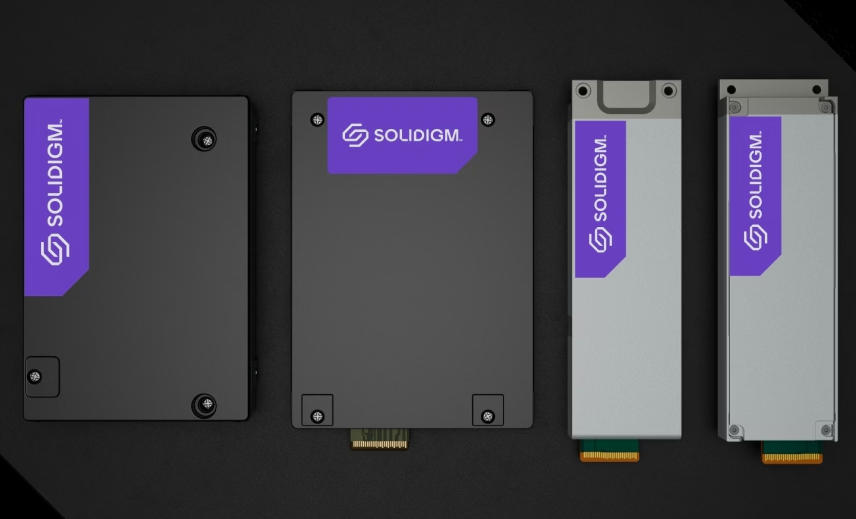
The E1.S form factor has steadily become the default choice for AI data center storage hardware thanks to its high-density deployment advantages. But its compact package comes with a well-documented penalty: limited surface area for heat dissipation. Most E1.S SSDs respond by throttling under thermal load, which caps sustained performance exactly when workloads demand it most.
The Solidigm D7-PS1010 E1.S 7.68TB enterprise SSD removes that trade-off. Within the tight confines of the E1.S specification, it delivers flagship-class read and write performance alongside genuinely strong thermal behavior — giving AI compute clusters and next-generation data center storage builds a dependable foundation.
Product Positioning: Tuned for AI Read-Intensive Workloads
The Solidigm D7-PS1010 E1.S 7.68TB enterprise SSD is purpose-built for AI read-intensive workloads, with both hardware and firmware deeply optimized for GPU-driven AI data access patterns. Unlike conventional enterprise SSDs engineered mainly for low queue depths, the D7-PS1010 natively supports high queue depth operation — its validation coverage extends to QD4096, which maps directly onto the tens of thousands of concurrent storage requests generated by AI training and AI inference pipelines. It is a compelling storage choice for high-density servers and HPC clusters.
Measured Performance: Top Tier Among E1.S Drives
Drawing on third-party benchmark data from TweakTown and StorageReview, the Solidigm D7-PS1010 reaches 14,848 MB/s in 256K sequential read — ahead of comparable enterprise SSDs including the Kioxia CM7-R and Samsung PM1743.
Random I/O is equally strong:
Metric | Measured Result |
4K random read | Up to 2,084,960 IOPS |
4K random write | Up to 408,721 IOPS |
256K sequential read | 14,848 MB/s |
Energy efficiency (128KB sequential write, QD128) | 3,874 IOPS/W |
Measured numbers align with the official specifications — no gap between datasheet and real-world behavior. In the high-queue-depth scenarios typical of AI workloads, the drive's performance consistency stands out: GPU data pipelines keep a steady throughput and do not fall off a cliff when concurrent requests spike.
Thermal Innovation: Single-Sided PCB, Cold-Plate Liquid Cooling Ready
Limited heat dissipation area is the core weakness of the E1.S form factor, and most same-size SSDs can only manage temperature by throttling — sacrificing sustained performance. The Solidigm D7-PS1010 takes a different route: a single-sided PCB design that lets the drive surface sit flush against a cold plate, compatible with both fanless passive cooling and liquid-cooled chassis architectures.
It is also the industry's first E1.S enterprise SSD to support a single-sided cold-plate liquid cooling solution. That means data centers can migrate from air cooling to liquid cooling without a disruptive rebuild, unlocking flexible thermal options for high-density rack deployments and attacking the root cause of thermally induced throttling in cramped E1.S slots.
Far Better Energy Efficiency, Lower Data Center TCO
Power and cooling costs form the core of operating expenditure in large-scale data centers. The D7-PS1010 pushes efficiency substantially higher, with official figures citing a 70% efficiency improvement over comparable products.
Under a 128KB sequential write, QD128 test condition, the Solidigm D7-PS1010 achieves 3,874 IOPS/W. By comparison, the Samsung PM1743 measures just 2,272 IOPS/W in the same test environment. Higher efficiency means less power draw for the same I/O performance — cutting electricity costs while reducing the overall cooling burden on the rack, which together translate into a materially lower total cost of ownership (TCO) for cluster deployments.
Verdict: A High-Density Storage Cornerstone for the AI Era
The Solidigm D7-PS1010 E1.S 7.68TB enterprise SSD dismantles the assumption that E1.S drives must choose between performance and thermals. It packs flagship read/write performance, an innovative single-sided liquid-cooling architecture, and industry-leading efficiency into a compact E1.S footprint.
As AI computing infrastructure keeps evolving toward higher density and better energy efficiency, demand for E1.S enterprise SSDs will continue to climb. The Solidigm D7-PS1010 is more than a fast enterprise SSD — its design philosophy points the way forward for high-density storage hardware in AI and HPC environments, making it a key building block for next-generation data center storage infrastructure.