
Breaking QLC Stereotypes! SanDisk WD Blue SN5100 SSD Review: Full PCIe 4.0 Performance & Stable Output
For content creators and hardcore gamers, insufficient PC storage space has become a common dilemma. 4K ultra-HD video footage, large-scale game installations of dozens or hundreds of GB, and massive office files continue to consume drive storage over time. Traditional old hard drives struggle with slow read/write speeds, limited capacity and poor stability, making system upgrades urgent. For cost-effective PC storage expansion, an SSD with large capacity, high speed, low speed drop and reliable thermal control is essential. Today, we present a comprehensive hands-on review of the SanDisk WD Blue SN5100 2TB SSD. As a new-generation PCIe 4.0 drive in the WD Blue consumer lineup, can it break the long-standing stereotype that QLC flash delivers sluggish performance and severe speed degradation? Real benchmark test data will tell the truth.
1. Packaging, Appearance & Hardware Layout: User-Friendly Positioning & Wide Compatibility
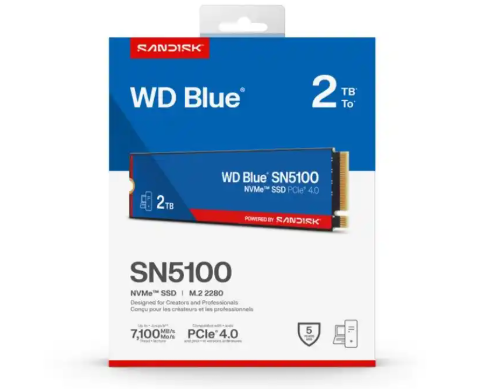
The SanDisk WD Blue SN5100 inherits the classic blue, white and red color scheme of the WD Blue series, delivering a clean and premium visual experience. The front of the packaging features a product render, paired with the iconic red SanDisk brand logo and clear capacity specifications. Marked prominently on the box are the PCIe 4.0 standard and a peak sequential read speed of 7100MB/s, directly highlighting its mainstream consumer high-performance positioning and core capabilities.
The package contains only the SSD unit and an official user manual with streamlined accessories. Adopting the standard M.2 2280 form factor and a single-sided particle layout, all electronic components, flash particles and the main controller are mounted on the front PCB, with no parts on the back. This compact design offers excellent compatibility with thin-and-light laptops, mini PCs and ITX small chassis with tight internal space, outperforming dual-sided SSDs in device adaptability. The center of the PCB is printed with basic product specifications and serial numbers for complete traceability, reflecting solid manufacturing quality.
In terms of hardware architecture, the SN5100 adopts a DRAM-less design without independent cache. It is equipped with SanDisk self-developed A101-000103-A1 main controller, supporting NVMe 2.0 protocol, full-speed PCIe 4.0 x4 interface, HMB memory buffer technology and intelligent SLC cache technology. The built-in power management chip ensures stable power supply and low power consumption. The rational layout and sufficient spacing between the main controller and flash particles avoid concentrated heat generation, effectively reducing the risk of thermal throttling through optimized hardware structure.
For flash memory, this SSD utilizes SanDisk BICS 8 QLC 3D CBA NAND particles with the printing code 029156 2T00. The single particle supports up to 2TB capacity and integrates nCache 4.0 acceleration technology. The product lineup covers 500GB, 1TB, 2TB and 4TB specifications, among which 500GB, 1TB and 2TB versions are widely available on the market. The 2TB model is highly recommended for daily use for balanced cost performance and practicality.
2. Core Specifications & Warranty Endurance: Sufficient for Daily Scenarios
The official rated performance of the 2TB SanDisk WD Blue SN5100 reaches flagship-level standards for mainstream PCIe 4.0 SSDs: sequential read speed up to 7100MB/s, sequential write speed up to 6700MB/s, 4K random read IOPS of 1000K and 4K random write IOPS of 1300K.
Warranty and write endurance are critical indicators for storage devices. This SSD comes with a 5-year limited official warranty with differentiated TBW ratings for different capacities: 900TBW for the 2TB version and 600TBW for the 1TB version. Based on daily usage for video creation (average daily write volume of 200GB for footage editing and file processing), the total 5-year write volume is only about 350TB, far below the 900TBW rated endurance. It fully meets the demands of daily office work, game storage and video material archiving with reliable long-term service life.
3. Cross-Platform Test Environment: Dual Platform Verification for Authentic Data
To eliminate platform deviation and ensure authentic, objective test results, we built two mainstream hardware platforms covering Intel and AMD ecosystems with unified test conditions:
Intel Platform: Intel Ultra7 265K CPU + Z890M Motherboard; the SSD is installed on the CPU-direct PCIe 5.0 M.2 slot, running in backward-compatible PCIe 4.0 mode.
AMD Platform: AMD Ryzen 9 9950X3D CPU + B850M Motherboard, running standard PCIe 4.0 transmission mode.
All tests were conducted with the factory-installed aluminum alloy heat sink and constant room temperature. Multiple professional benchmark tools, full-drive stress tests and real-game loading tests were adopted to comprehensively verify the SSD’s performance and stability.
4. Basic Status Detection: Stable Operation & Outstanding Thermal Control
CrystalDiskInfo detection shows that the SN5100 runs in full-speed PCIe 4.0 x4 mode, fully supporting NVMe 2.0 protocol, SMART, TRIM, VolatileWriteCache and other core optimization technologies with complete protocol specifications. The idle temperature is only 26℃ with excellent thermal performance. The actual usable capacity of the formatted 2TB version is 1.81TB, which conforms to standard industry conversion rules.
Users can monitor real-time operating status including SSD temperature, remaining capacity and read/write speed via the exclusive SanDisk Dashboard. The software also supports one-click firmware updates, secure data erasure, write cache switching and TRIM function management, enabling visualized and convenient daily maintenance.
5. Multi-Software Benchmark Test: Full-Speed Output & Flagship-Level Performance on Dual Platforms
5.1 Crystal Disk Mark Test
On the Intel platform, the SSD achieves a sequential read speed of 7122MB/s and sequential write speed of 6721MB/s, slightly exceeding official nominal values. The 4K single-thread read speed hits 114.92MB/s and write speed reaches 309.23MB/s, with 4K random read/write IOPS reaching 1199K/1463K, delivering impressive small-file performance.
On the AMD platform, the sequential read speed rises to 7332MB/s with a sequential write speed of 6726MB/s. It stably runs at full PCIe 4.0 bandwidth on both platforms without compatibility issues.
5.2 ATTO Disk Benchmark Test
In small-file tests, the 4K file read/write speeds reach 321MB/s and 732MB/s respectively. For files larger than 64KB, the SSD instantly reaches full speed, with a maximum read speed of 6.64GB/s and maximum write speed of 6.27GB/s. The excellent large-file transmission efficiency perfectly adapts to video footage migration and large game file copying scenarios.
5.3 3DMark Storage Benchmark
In the professional 3DMark storage test, the SN5100 scores 4237 points, with an average bandwidth of 700MB/s and an ultra-low average access time of 45μs. In the Battlefield V game loading test, the bandwidth reaches 1383MB/s, ensuring fast and responsive game loading.
5.4 PCMark10 Data Drive Benchmark
Tested under PCMark10’s professional data drive mode focusing on daily storage, file copying and program operation scenarios, the SSD scores 5899 points with an average bandwidth of 862.88MB/s and an average access time of only 26μs. It ranks in the top tier of consumer-grade SSDs, ensuring smooth processing of high-frequency reading, writing and fragmented files.
5.5 TxBENCH Test
With stricter test thresholds, TxBENCH delivers slightly lower data than Crystal Disk Mark but still shows stable performance: sequential read speed of 7060MB/s, sequential write speed of 6725MB/s, 4K single-thread random read speed of 106.765MB/s and write speed of 266.860MB/s, maintaining high-performance output under rigorous test conditions.
6. Extreme Stress Test: Cache Performance, Full-Drive Speed & Thermal Stability
6.1 Full-Drive Write Stress Test
The SN5100 presents a stable two-stage write curve in the empty-drive full write test without severe speed drops or frequency throttling. The empty-drive SLC cache size is approximately 470GB, maintaining a steady write speed of 6500MB/s within the cache range. After the cache is exhausted and switched to direct write mode, it still sustains a continuous write speed of 450MB/s. The total time for a full 2TB drive write is only 55 minutes with extremely stable overall performance.
6.2 90% Storage Occupancy Performance Test
Most SSDs suffer obvious speed degradation under high storage occupancy. To simulate real daily usage, we tested the performance with the drive filled to 90% capacity. The test results show sequential read speed of 7119MB/s and sequential write speed of 6425MB/s. The read speed is almost consistent with the empty-drive state, with only a slight write speed attenuation that is negligible for daily use, solving the common slowdown pain point of high-capacity SSDs.
6.3 Real-Game Loading Test
To verify gaming performance, we conducted real-scene loading tests on Forspoken with three high-quality, high-complexity game scenes. The loading times are 2.003s, 1.851s and 1.026s respectively. There is almost no difference in loading speed between 90% occupancy and empty-drive status, ensuring zero stuttering scene switching and stable long-term gaming experience.
6.4 Thermal Performance Test
Equipped with dual temperature sensors for real-time monitoring of the main controller and flash particles, the SSD was tested under full-load write pressure at a room temperature of 28℃ with the official heat sink installed. The maximum temperature of the main controller is 58℃, and the maximum flash particle temperature is 62℃. It delivers excellent thermal control under extreme loads with no high-temperature throttling or overheating lag.
7. Review Conclusion: Redefining the Cost Performance of QLC SSDs
QLC flash SSDs have long been stereotyped as slow and unstable with severe speed degradation. However, the comprehensive test results of the SanDisk WD Blue SN5100 2TB SSD completely reverse this outdated perception.
Adopting a DRAM-less architecture and QLC 3D NAND flash, this PCIe 4.0 SSD achieves performance comparable to mainstream TLC SSDs thanks to SanDisk’s in-depth firmware optimization, 470GB large-capacity SLC cache and stable direct-write speed. It fully taps the potential of the PCIe 4.0 x4 interface with 7100MB/s maximum read speed and 6700MB/s maximum write speed, delivering outstanding 4K random read/write capability, fragmented file processing and high-load stability.
It maintains consistent high-performance output in both empty-drive and 90% high-occupancy scenarios, supporting ultra-fast game loading and efficient video file copying and editing. Combined with reliable thermal control, 900TBW high write endurance and 5-year official warranty, it balances performance, stability and service life perfectly.
Ideal for video content creators, hardcore gamers and daily office users, the SanDisk WD Blue SN5100 is a cost-effective and practical storage upgrade option. It fully meets the core demands of large-capacity storage, high-speed transmission and long-term stable operation, standing out as a reliable and worthwhile mainstream PCIe 4.0 consumer-grade SSD.