Intel D7-P5520 vs SK Hynix SE5110 Enterprise SSD: Interface, Architecture Differences and Application Adaptation Analysis
In enterprise data center storage selection, most IT practitioners prioritize intuitive SSD specifications such as capacity, sequential read/write speeds, and random IOPS to evaluate hardware performance levels. The Intel D7-P5520 and SK Hynix SE5110 represent two enterprise-grade SSDs with completely different market positioning, showing a massive gap in nominal performance data. The former delivers a maximum sequential read and write speed of 7100MB/s, while the latter maintains a steady speed of approximately 550MB/s. Nevertheless, for long-term enterprise deployment, workload adaptation, and OPEX control, underlying distinctions includinginterface protocols, hardware architectures, caching mechanisms, and endurance designs determine the practical value and scenario compatibility of enterprise SSDs far more significantly than superficial performance parameters. Based on the core hardware specifications of the two drives, this article comprehensively analyzes their technical logic and selection criteria from four dimensions: structural design, process roadmap, technical disparities, and practical application scenarios.
1. Core Hardware Specifications and Basic Positioning of Two Enterprise SSDs
1.1 Intel D7-P5520 (PCIe 4.0 NVMe High-End Enterprise SSD)
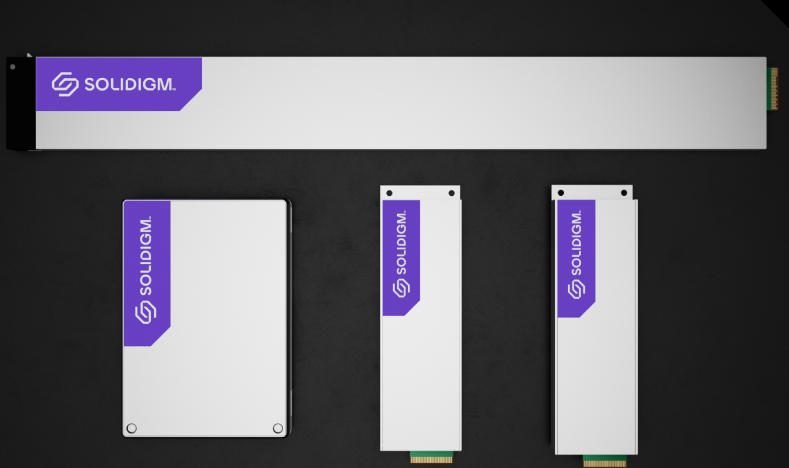
The Intel D7-P5520 is a high-performance enterprise solid-state drive engineered for heavy-load data center environments. It adopts the industry-standard U.2 15mm form factor and equips a PCIe 4.0 x4 high-speed interface alongside the standard NVMe protocol, with a 7.68TB high-capacity version adopted for this comparative analysis. In terms of performance, the drive delivers extreme throughput and concurrent processing capabilities, with sequential read and write speeds both reaching 7100MB/s, 4K random read IOPS of 1,100,000, and 4K random write IOPS of 220,000.
In terms of reliability and durability, the D7-P5520 features a total bytes written (PBW) endurance rating of 14.0 PB and comes with an official 5-year warranty, supporting an operating temperature range from 0℃ to 70℃. Leveraging the advantages of the NVMe architecture, this SSD establishes a direct CPU communication channel via the PCIe bus, eliminating redundant overhead from traditional transmission protocols, effectively reducing data latency, and greatly enhancing multi-task parallel processing capability. Supported by the hot-swap function of the U.2 interface, it perfectly adapts to high-density and intensive storage deployment in data centers, featuring core strengths of high throughput, superior endurance, and ultra-low latency.
1.2 SK Hynix SE5110 (SATA Entry-Level Enterprise SSD)
The SK Hynix SE5110 is an entry-level enterprise solid-state drive focused on high stability and cost efficiency. It adopts the classic 2.5-inch SATA form factor, equipped with a SATA 3.0 interface and AHCI protocol, with a 480GB capacity model used for this comparison. In terms of performance specifications, it delivers a peak sequential read speed of 550MB/s, a sequential write speed of 510MB/s, and 4K random write IOPS of 26,000. It features stable and balanced overall performance without extreme high-speed output.
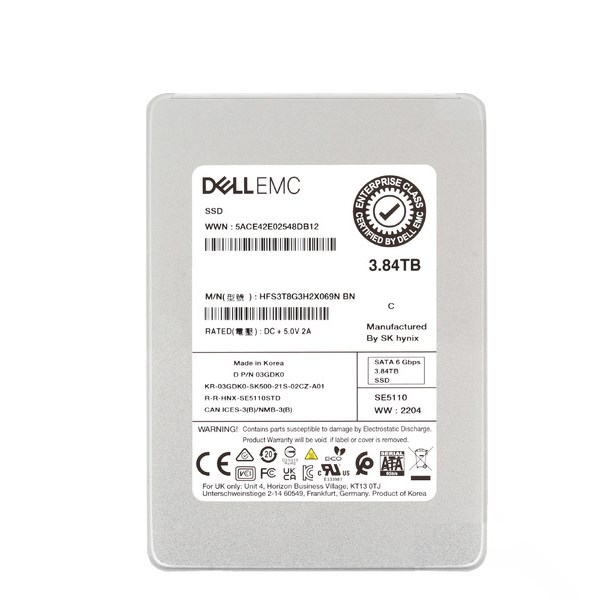
In terms of hardware architecture, the SE5110 adopts enterprise-grade 3D-V6 TLC NAND flash particles and integrates an independent DRAM cache module to optimize small-file read and write efficiency. For reliability, the drive boasts a mean time between failures (MTBF) of 2,000,000 hours and a maximum operating temperature of 70℃. Designed for long-term stable operation, it relies on the mature SATA ecosystem to be compatible with traditional servers and legacy storage architectures, occupying the entry-level enterprise storage market with outstanding compatibility and cost advantages.
2. Core Technical Differences: Generational Gap Between Interface Protocols and Storage Architectures
The performance gap between the two drives does not stem from simple hardware tuning. Essentially, it reflects the generational technical difference between the new-generation PCIe NVMe high-speed architecture and the traditional SATA AHCI classic architecture. Comprehensive disparities in interface bandwidth, protocol logic, and hardware architecture fundamentally define their performance ceilings and workload adaptation capabilities.
2.1 Differences in Transmission Interfaces and Bandwidth Ceilings
Bandwidth acts as the core bottleneck restricting SSD transmission speed. The PCIe 4.0 x4 channel equipped by the Intel D7-P5520 provides a theoretical single-channel bandwidth of 2GB/s, with a total four-channel theoretical bandwidth of up to 8GB/s, providing sufficient hardware support for ultra-high-throughput data transmission. In contrast, the SATA 3.0 interface adopted by the SK Hynix SE5110 has a theoretical industry bandwidth of only 6Gbps, equivalent to approximately 750MB/s of transmission bandwidth. Affected by protocol loss and bus overhead, its actual effective read and write speed stabilizes at around 550MB/s, creating a quantitative gap in bandwidth ceiling compared with the PCIe 4.0 architecture.
2.2 Differences in Transmission Protocols and Concurrent Processing Capabilities
Protocol architecture disparity is the core cause of the concurrent performance gap between the two SSDs. Custom-built exclusively for flash-based solid-state drives, the NVMe protocol completely abandons the design limitations of mechanical hard disk era protocols. It supports multi-queue and multi-thread parallel command processing, fully releasing the flash read-write advantages of SSDs and maintaining low-latency and high-stable transmission status even in high-concurrency and deep-queue-depth business scenarios.
On the contrary, the AHCI protocol deployed by the SK Hynix SE5110 was originally designed for mechanical hard disk transmission, featuring outdated architecture and high redundant overhead with support for only single-queue command processing. It performs stably in conventional light-load and shallow-queue scenarios. However, when facing high-concurrency and multi-thread random read-write demands in data centers, it is prone to queue congestion, latency surge, and throughput limitation, becoming the core bottleneck of overall storage performance.
2.3 Differences in Hardware Form Factors, Scalability and Heat Dissipation
Different hardware form factors lead to distinct scalability and heat dissipation capabilities. The Intel D7-P5520 adopts a thickened U.2 15mm design, reserving sufficient internal heat dissipation space to accommodate high-performance main controllers and large-capacity flash particles. Its superior heat dissipation efficiency supports sustained high-load high-speed read and write operations. Meanwhile, it supports 7.68TB large-capacity expansion, perfectly suitable for high-density and large-scale storage deployment.
The SK Hynix SE5110 features a universal 2.5-inch standard SATA form factor with a compact size and excellent universal compatibility, supporting most legacy servers and storage devices. Nevertheless, its limited body structure cannot accommodate large-capacity particles and high-efficiency heat dissipation modules, resulting in a low capacity expansion ceiling and weak sustained heat dissipation performance under heavy loads. It is only applicable to stable and light-duty operating scenarios.
3. Endurance, O&M and Long-Term Operational Differences
The core value of enterprise-level SSDs lies not only in instantaneous performance output but also in long-term operational stability, durable resistance to heavy workloads, and convenient maintenance. The differentiated design positioning of the two drives is prominently reflected in long-term application scenarios.
3.1 Differences in Endurance Ratings and Workload Adaptation
Equipped with a 14.0 PBW ultra-high write endurance rating and a 5-year official warranty, the Intel D7-P5520 delivers exceptional write resistance. Calculated based on the full warranty cycle, the drive can sustain a continuous daily write volume of 7.67TB within 5 years. It is an ideal solution for high-write and high-throughput heavy-load scenarios, including high-frequency database reading and writing, server virtualization, real-time data analysis, and cloud computing power support, with no performance degradation or service life risks during long-term high-load operation.
The SK Hynix SE5110 is not rated with PBW write endurance parameters, and its core reliability advantage lies in the 2,000,000-hour MTBF rating. Its design focuses on long-term stable operation and low failure rate rather than high write durability. This drive is more suitable for read-intensive businesses, cold data backup, static file storage, background light-load caching, and other low-write and high-read lightweight scenarios. It maintains excellent stability in long-term light-load operation but cannot withstand high-frequency sustained write workloads.
3.2 Differences in O&M Convenience and Heat Dissipation Requirements
In terms of operation and maintenance, both drives support hot-swap functionality, enabling hard disk replacement and maintenance without equipment shutdown and reducing data center outage risks. However, the U.2-interface D7-P5520 features higher integration, adapting to modern high-density server cabinets with simplified wiring and high overall integration, making it more suitable for large-scale cluster O&M. The SATA-interface SE5110 has higher wiring complexity. Although it is highly compatible with legacy devices, its operational efficiency is limited in cluster deployment scenarios.
In terms of heat dissipation, both drives adapt to standard data center ambient conditions with a maximum operating temperature of 70℃. Nevertheless, the D7-P5520 generates more heat under continuous high-throughput and high-concurrency operating conditions due to its high-performance characteristics, imposing higher requirements on computer room air duct design, heat dissipation systems, and ventilation environments. In comparison, the SE5110 operates with low power consumption and low heat generation, meeting long-term operational demands with conventional computer room heat dissipation conditions and lowering overall O&M thresholds.
4. Enterprise SSD Selection Framework: Accurate Business Scenario Matching
Combined with the interface architecture, performance characteristics, endurance capabilities, and O&M features of the two drives, a standardized enterprise SSD selection logic can be summarized to help enterprises select storage solutions accurately based on business conditions, balancing performance requirements and cost-effectiveness.
1. Interface and Protocol Selection: The PCIe 4.0 + NVMe architecture adapts to core business scenarios requiring low latency, high concurrency, and high throughput, such as core databases, real-time computing, virtualization clusters, and cloud hosts. The SATA 3.0 + AHCI architecture is suitable for businesses with low bandwidth and low concurrency requirements, including legacy device capacity expansion, cold data storage, and static resource caching.
2. Endurance and Capacity Selection: High-PBW and large-capacity SSDs focus on write durability, adapting to businesses with high-frequency writing and sustained throughput. High-MTBF and small-capacity SSDs prioritize stable operation, ideal for read-intensive, low-write, and long-term standby business scenarios.
3. Form Factor and Heat Dissipation Selection: The U.2 15mm form factor fits modern high-density computer rooms and large-scale cluster deployment, requiring matched high-quality heat dissipation air ducts. The 2.5-inch SATA form factor delivers full compatibility with legacy servers and small-scale computer rooms without special heat dissipation design, yet it has limited storage expansion density.
4. Caching Strategy Selection: SATA SSDs with independent DRAM caches can compensate for small-file read-write weaknesses, but their performance ceiling is restricted by interface bandwidth. Benefiting from protocol parallel optimization, the NVMe architecture achieves extreme random read-write performance without relying on large-capacity caches, delivering superior comprehensive performance.
5. Conclusion
The gap between the Intel D7-P5520 and SK Hynix SE5110 is far more than a simple performance disparity; it represents two distinct technical roadmaps for high-end high-performance data center storage and entry-level high-compatibility enterprise storage. Armed with the PCIe 4.0 NVMe high-speed architecture, ultra-high endurance rating, and large-capacity scalability, the D7-P5520 fully adapts to enterprise core heavy-load businesses, delivering extreme performance and long-term reliability. The SE5110 relies on a mature SATA ecosystem, high stability, and low-cost advantages to fit lightweight scenarios such as edge storage, cold data archiving, and legacy device upgrades. In enterprise storage selection, blind pursuit of peak performance is not recommended. Matching SSD solutions with actual business workloads, equipment architectures, and O&M needs enables optimal utilization of storage resources.