
Detailed Explanation of NVIDIA RTX PRO 5000 Blackwell Parameters and Performance
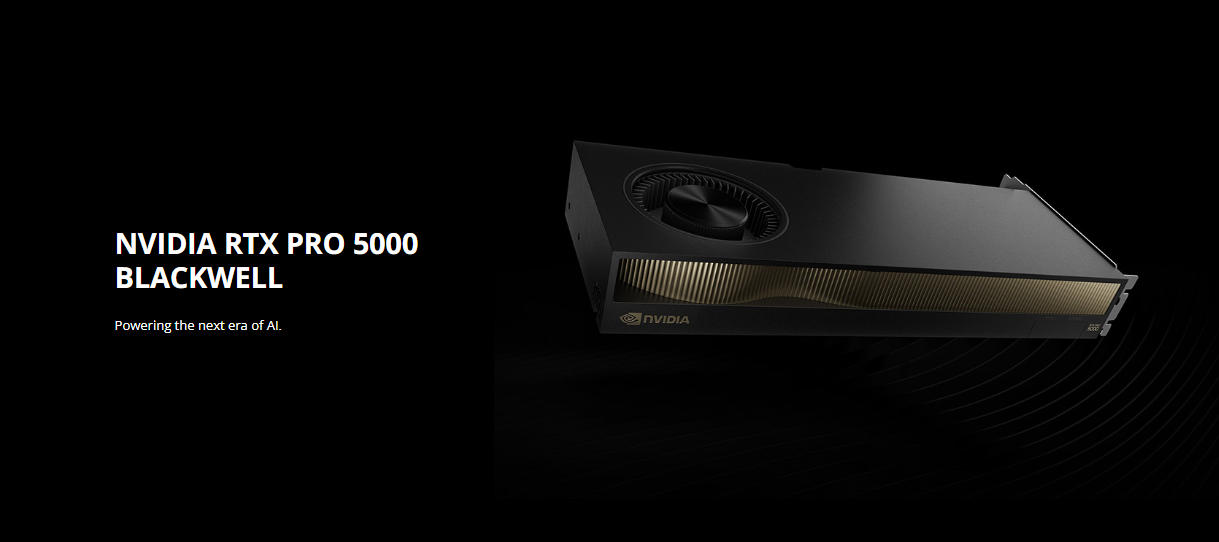
The NVIDIA RTX PRO™ 5000 Blackwell pushes artificial intelligence and neural rendering performance to unprecedented levels. Constructed upon NVIDIA’s Blackwell architecture and fitted with 48 GB of ultra‑fast GDDR7 memory, this desktop‑class GPU provides full‑scale acceleration for AI development, large language model inference, generative‑AI pipelines, photorealistic simulation tasks, video content creation, and intricate 3D modelling work. Powered by the RTX PRO 5000, users can operate on‑device AI assistants reliably at high speeds, generate lifelike visual outputs through neural‑rendering techniques, and refine high‑accuracy simulation workflows essential to engineering projects and scientific investigation.
Fifth‑Generation Tensor Cores
Boasting up to three‑fold performance gains versus its predecessor, fifth‑generation Tensor Cores include native FP4 precision alongside DLSS 4 multi‑frame generation capability. These units accelerate on‑premises large‑language‑model processing, facilitate rapid prototyping of novel AI models, and elevate overall output quality for content creation and graphics workloads.
Fourth‑Generation RT Cores
Fourth‑gen RT Cores deliver as much as 2× greater performance compared to the prior iteration, cutting down render times for media & entertainment production, AEC workflows, and manufacturing prototype development. Leveraging neural‑graphic innovations including RTX Mega Geometry, users are able to build realistic, immersive 3D environments with up to 100‑fold increases in ray‑traced triangle geometry volume.
CUDA Cores
As the most capable professional‑grade RTX GPU ever built on Blackwell, this hardware incorporates cutting‑edge Streaming Multiprocessor and CUDA® core architectures. Improved SM processing throughput combined with newly‑introduced neural shaders embeds neural network logic straight into programmable shader units, laying the groundwork for next‑generation advances in AI‑enhanced graphics over the coming years.
48 GB GPU Memory
Optimised GDDR7 memory delivers substantial improvements in memory bandwidth and capacity, yielding snappier application response and compatibility with bigger, more sophisticated datasets. Its 48 GB on‑board VRAM can accommodate sizeable 3D assets and AI‑focused initiatives, supports navigation within expansive virtual‑reality scenarios, and sustains complex multi‑software concurrent workflows.
9th‑Generation NVENC
NVIDIA’s 9th‑generation NVENC hardware encoder greatly accelerates video encoding operations while elevating visual fidelity for professional video tools. It introduces 4:2:2 colour sampling support for both H.264 and HEVC encoding, plus further quality optimisations for HEVC and AV1 compression standards.
6th‑Generation NVDEC
The 6th‑gen NVDEC decoder realises up to double the H.264 decoding throughput and supports 4:2:2 H.264 and HEVC decode operations. Creative specialists gain access to premium video playback, faster raw‑video import pipelines, and sophisticated AI‑driven video editing functions.
PCIe Gen 5
Adoption of PCI Express Gen 5 doubles available bandwidth relative to PCIe Gen 4. It raises bidirectional data throughput between system CPU memory and GPU, unlocking faster execution for data‑heavy workloads such as artificial intelligence computation, data science analysis and 3D model manipulation.
DisplayPort 2.1
DisplayPort 2.1 brings outstanding visual fidelity and performance, supporting display outputs reaching 8K 240 Hz and 16K 60 Hz. Expanded bandwidth ensures seamless multi‑screen arrangements well‑suited for multitasking and team collaboration. HDR and increased colour bit‑depth maintain precise colour reproduction for accuracy‑demanding jobs: video editing, 3D design work and live broadcast production included.