
Core Technical Differences Between Enterprise SSDs: Intel S4620 vs Solidigm D3-S4520
In modern enterprise storage architectures, SATA interface solid-state drives (SSDs) have become a mainstream storage option for enterprise data centers, virtualization platforms, and business servers. Their widespread adoption stems from mature technology, excellent compatibility, and cost-effective performance. Restricted by the inherent bandwidth ceiling of the SATA 3.0 protocol, enterprise-grade SSDs with identical interfaces deliver highly consistent sequential read and write speeds. Nevertheless, substantial essential technical disparities exist across different models in terms of flash memory architecture, endurance mechanisms, cache configurations, performance tuning, and capacity positioning.
The Intel S4620 and Solidigm D3-S4520 are two flagship enterprise SATA SSDs with nearly identical official sequential performance specifications, making it difficult for most users to distinguish their applicable scenarios through basic parameters. In fact, the core distinctions between the two drives lie in random read/write capabilities, endurance ratings, flash memory processes, and workload adaptation logic, which serve as critical foundations for enterprise storage selection, workload tiering, and service life planning. Based on official hardware specifications, this article conducts an in-depth analysis of their technical differences and provides targeted selection guidance for diverse enterprise business scenarios.
1. Core Hardware and Performance Specifications of Intel S4620 (960GB)
The 960GB Intel S4620 adopts standard enterprise-grade hardware configurations. Equipped with a SATA 3.0 (6Gb/s) transmission interface and a universal 2.5-inch 7mm slim form factor, it boasts exceptional compatibility with most enterprise servers, disk arrays, and storage cabinets.
In terms of performance, this SSD delivers a maximum sequential read speed of 550MB/s and a peak sequential write speed of 510MB/s. It stands out prominently in random workloads, achieving a 4K random read performance of 90,000 IOPS and a 4K random write performance of 54,000 IOPS, with superior random performance acting as one of its core competitive advantages.
Endurance and service lifespan are the most prominent strengths of the Intel S4620. Officially rated at up to 4.0 DWPD (Drive Writes Per Day) and a total byte written (TBW) limit of 7.1 PBW, the drive is backed by a 5-year original manufacturer warranty. Its operating temperature range spans from 0℃ to 70℃, fully accommodating continuous high-load operation in constant-temperature data center environments.
Positioned as a high-endurance and high-random-write enterprise SSD, the Intel S4620’s 4.0 DWPD rating enables it to sustain intensive daily write workloads equivalent to four times the full drive capacity throughout the warranty period. It is specially optimized for write-intensive scenarios including log storage, cache acceleration layers, and frequently updated business systems, effectively reducing flash wear rates, lowering hardware replacement costs, and ensuring long-term stable business operation.
2. Core Hardware and Performance Specifications of Solidigm D3-S4520 (3.84TB)
The 3.84TB Solidigm D3-S4520 features the industry-standard SATA 3.0 6Gb/s interface and the exact same 2.5-inch 7mm physical dimensions as the Intel S4620, enabling seamless compatibility with all types of enterprise storage devices with zero hardware adaptation barriers.
It maintains consistent sequential read and write performance with the Intel S4620, offering peak speeds of 550MB/s for reads and 510MB/s for writes, delivering equivalent performance in large-file transmission and batch data processing scenarios. However, it registers a significantly lower 4K random write performance of 30,000 IOPS, which constitutes the core performance gap and determines the differentiated workload adaptability of the two drives.
In terms of hardware architecture, the D3-S4520 utilizes TLC flash memory and integrates an independent DRAM cache design. This configuration effectively stabilizes read and write response speeds under multi-queue-depth workloads, suppresses performance fluctuations, and guarantees steady-state operational reliability. It carries an endurance rating of 2.2 DWPD and an MTBF (Mean Time Between Failures) of up to 2,000,000 hours, alongside a 5-year official warranty, focusing on large-capacity storage and ultra-high operational stability with low failure rates.
The Solidigm D3-S4520 is positioned as a high-density large-capacity enterprise storage drive. Its 3.84TB single-drive capacity is four times that of the 960GB Intel S4620. Despite its lower DWPD rating, its large-capacity design delivers sufficient overall write lifespan to meet conventional enterprise business demands. It is primarily applicable to read-dominant scenarios such as large-scale data archiving, static resource storage, and mass data repository services.
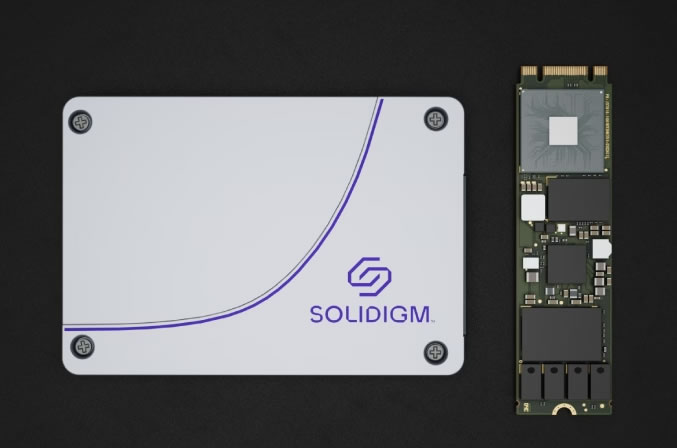
3. In-Depth Analysis of Core Technical Differences Between the Two Enterprise SSDs
Beyond standardized basic specifications, the Intel S4620 and Solidigm D3-S4520 differ fundamentally in three key dimensions: endurance architecture, random performance, and hardware positioning, which define their respective business application boundaries.
3.1 Differences in Flash Endurance and Write Lifespan Design
Endurance rating represents the most critical technical distinction between the two models. The Intel S4620 supports up to 4.0 DWPD, while the Solidigm D3-S4520 is rated at 2.2 DWPD. This gap originates from differentiated flash particle selection, firmware optimization mechanisms, and write amplification control algorithms. The S4620 adopts advanced error correction algorithms, optimized SLC cache scheduling strategies, and high-grade flash particles to minimize write wear under heavy loads, enabling superior daily write tolerance. Supported by a clear 7.1 PBW total write capacity, it delivers outstanding lifespan advantages in long-term high-frequency write scenarios. In contrast, the D3-S4520 compensates for its lower single-drive endurance with larger storage capacity, making it more suitable for business environments with sustained low-intensity write workloads.
3.2 Substantial Gap in Random Write Performance
In core enterprise business scenarios, 4K random IOPS serves as a vital metric for evaluating the performance of databases, virtualization platforms, and transaction processing systems. The Intel S4620’s 54,000 4K random write IOPS far exceeds the D3-S4520’s 30,000 IOPS. This performance disparity stems not only from the inherent read-write characteristics of flash memory particles but also from differentiated tuning of main control channel scheduling algorithms, firmware read-write policies, and cache operating mechanisms. High random write performance effectively reduces business latency and enhances concurrent processing capabilities, which are essential for high-frequency transaction processing and dynamic database update scenarios. Conversely, the Solidigm D3-S4520 faces obvious performance bottlenecks in high-concurrency random write workloads.
3.3 Divergent Capacity Positioning and Hardware Architecture Focus
The 960GB Intel S4620 prioritizes performance and endurance, allocating hardware resources predominantly to write optimization and wear reduction. In comparison, the 3.84TB Solidigm D3-S4520 focuses on improving storage density to meet enterprise mass data storage requirements. Equipped with an independent DRAM cache, it ensures stable multi-task read and write performance. The large-capacity design imposes higher requirements on main control channel utilization, heat dissipation management, and NAND chip parallel processing capabilities, shifting the design focus from anti-wear performance to high-capacity steady-state operation.
4. Scenario Adaptation and Long-Term Application Value Analysis
4.1 Intel S4620: Optimal Choice for Write-Intensive Workloads
Benefiting from its 4.0 DWPD high endurance, industry-leading random write IOPS, and 7.1 PBW total write lifespan, the Intel S4620 is perfectly suited for latency-sensitive and write-heavy core enterprise businesses. Typical application scenarios include online transaction processing systems, high-frequency database updating, server log storage, storage cache acceleration layers, and dynamic virtualization resource pools. Under high daily write load conditions, the drive maintains stable long-term performance, slows flash memory aging, extends equipment service life, and reduces enterprise hardware iteration and operation maintenance costs.
4.2 Solidigm D3-S4520: Premier Large-Capacity Read-Oriented Storage Solution
Leveraging its 3.84TB ultra-large capacity, independent DRAM cache, and high MTBF stability, the Solidigm D3-S4520 adapts well to read-intensive and light-hybrid write workloads. It is widely deployed in enterprise mass file archiving, CDN content distribution nodes, static resource storage pools, and large-scale virtualization storage clusters. These scenarios are dominated by data reading and archiving with low write frequency and light load pressure, where the 2.2 DWPD endurance rating fully meets long-term operational demands. Additionally, its high single-drive capacity effectively saves cabinet slot resources and reduces overall system power consumption and heat dissipation pressure.
5. Enterprise SSD Selection Criteria
Based on the technical differences between the two drives, enterprises can make accurate selection decisions matching business workloads through four core dimensions:
First, evaluate daily write workloads. For businesses with daily write volumes reaching twice the full drive capacity or higher, the high-DWPD Intel S4620 is recommended to avoid excessive flash wear and premature hardware aging. For low-write and high-read business environments, the Solidigm D3-S4520 delivers superior cost-performance via large-capacity storage.
Second, clarify random write performance requirements. Scenarios involving database operations, high-concurrency transactions, and dynamic virtualization must prioritize 4K random write IOPS indicators, selecting the high-performance S4620 to guarantee low-latency and high-concurrency business operation.
Third, assess cache architecture value. The DRAM-cache-equipped D3-S4520 provides higher steady-state read-write consistency with minor performance fluctuations during multi-task parallel processing. In contrast, cache-free high-endurance SSDs focus on extreme write performance for specialized heavy-load scenarios.
Fourth, balance capacity planning and hardware costs. For scenarios with limited cabinet slots and high-density storage demands, large-capacity SSDs effectively reduce operational costs. For enterprises building tiered storage architectures combining write acceleration and data archiving, the combined deployment of the two models achieves an optimal balance between performance and capacity.
Conclusion
The Intel S4620 and Solidigm D3-S4520 are not iterative replacement products but enterprise SATA SSDs with differentiated market positioning. Both deliver consistent sequential performance, physical dimensions, and warranty cycles, yet they differ vastly in endurance level, random write capability, architectural design, and scenario adaptability. The Intel S4620 focuses on high endurance, superior random write performance, and heavy-load adaptability, serving as a mandatory choice for core write-intensive businesses. The Solidigm D3-S4520 targets large-capacity, high-stability, and high-density storage, perfectly matching enterprise mass data archiving and read-dominant business scenarios. Selecting the appropriate SSD based on actual business workload characteristics, write intensity, and storage requirements maximizes hardware utilization value and enables efficient, stable, and low-cost operation of enterprise storage systems.