
Blackwell Architecture's Pinnacle: A Technical Analysis of the NVIDIA GeForce RTX 5090
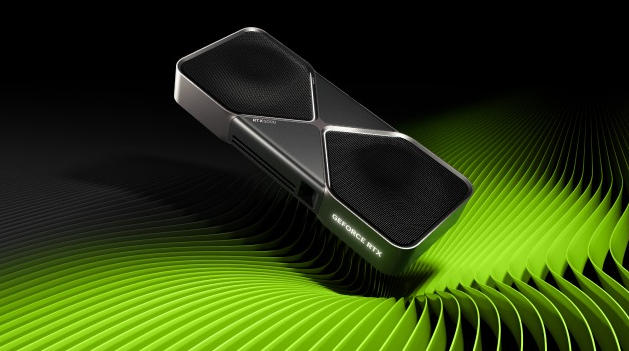
The RTX 5090 is NVIDIA’s new flagship consumer GPU built on the Blackwell architecture, succeeding the Ada Lovelace-based RTX 4090. Positioned as an all-round computing core for high-end gaming, real-time ray tracing, AI generative rendering and professional content creation, it delivers comprehensive upgrades to streaming multiprocessors, ray tracing cores, Tensor AI cores, the memory subsystem and video codec pipeline. It marks the first adoption of GDDR7 memory on a GeForce flagship, pushing the consumer GPU limits of AI compute, massive geometry ray tracing and high-resolution rendering to new heights. This technical review covers architectural design, core execution units, memory, multimedia engines, software ecosystem, power and platform requirements, and applicable workloads.
1. Overview of Core Hardware Specifications
2. Blackwell Architecture: Redesigned Streaming Multiprocessors (SMs)
Blackwell is far more than a process upgrade. It is a new generation of streaming multiprocessors fundamentally rebuilt with an AI-first and ray-tracing-first design philosophy. While the Ada Lovelace architecture already tilted SM resources toward Tensor units, Blackwell further reallocates internal SM resources to natively support Neural Shaders, the foundational design direction of this generation.
1. 5th-Generation Tensor Cores
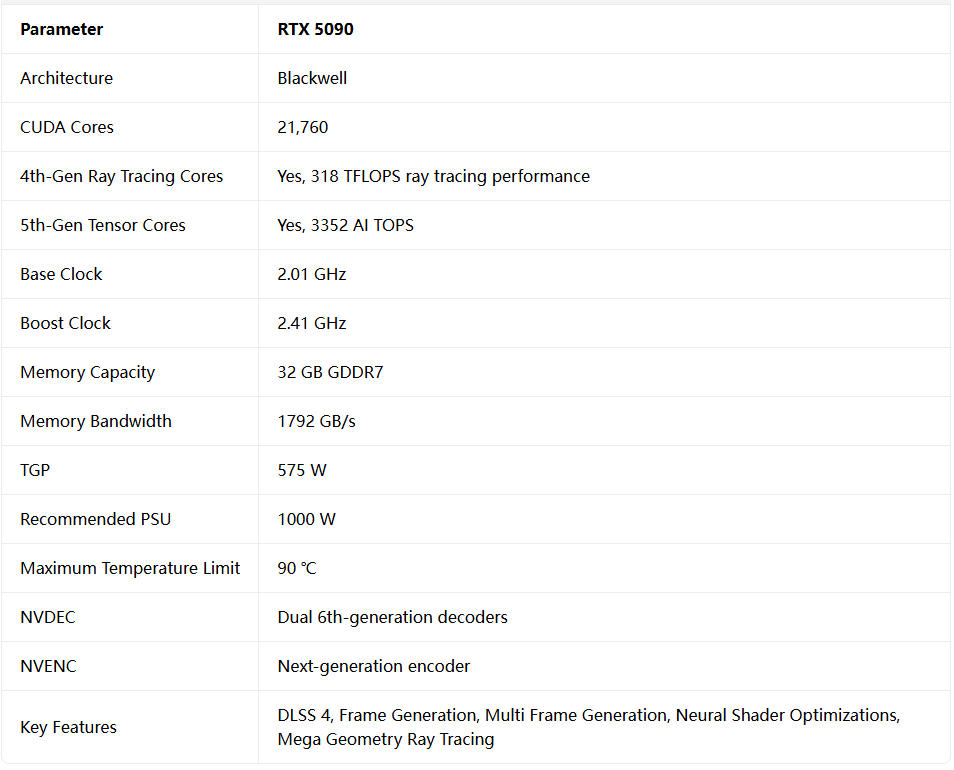
The 5th-gen Tensor Cores introduce a new FP4 low-precision mode, which drastically boosts throughput for lightweight AI inference. This serves as the compute foundation for DLSS 4, AI denoising, neural materials and real-time generative rendering. Compared with the prior generation, alongside existing FP16, BF16 and TF32 support, the newly added FP4 quantization enables aggressive performance gains for image upscaling, frame generation and local AI image synthesis under controlled accuracy budgets. With 3352 AI TOPS of AI compute power, the RTX 5090 functions not merely as a gaming GPU but also delivers substantial compute capacity for local large language models and image generation.
Tensor cores also feature optimized dataflow, reducing register and shared-memory stall latency between CUDA cores and Tensor units, making them ideal for hybrid rendering pipelines that run rasterization, ray tracing and AI enhancement concurrently.
2. 4th-Generation Ray Tracing Cores (RT Cores): Mega Geometry Optimization
The core objective of the 4th-gen RT Cores is to mitigate ray tracing bottlenecks caused by massive triangle counts, instanced geometry, vegetation, particles and procedural assets in modern games and virtual production — what NVIDIA refers to as Mega Geometry.
Previous-generation ray tracing cores suffered sharp performance degradation in BVH traversal and intersection testing when scene triangle counts exploded. Blackwell’s RT units include hardware-path optimizations for BVH traversal, instanced acceleration structures and surface intersection tests, greatly improving tracing efficiency for large-scale repeated instances and procedural geometry.
This enables Full Path Tracing to move beyond small-scale scenes, lifting the ceiling for sustained path tracing and high-sample denoising at 4K and 8K resolutions, a critical milestone for real-time ray tracing toward cinematic-grade rendering.
3. CUDA Cores and Rasterization Pipeline
The 21,760 CUDA floating-point cores retain formidable traditional rasterization performance, covering AAA gaming, CAD, Blender Cycles, V-Ray and other offline rendering workloads. Shared memory and L0 cache scheduling within SMs are revised to balance four types of workloads: conventional rasterization, compute shaders, ray tracing intersection shaders and AI inference, cutting overhead during task switching.
3. Memory Subsystem: GDDR7, Dual Gains in Bandwidth and Capacity
The RTX 4090 is equipped with 24 GB GDDR6X at 1008 GB/s bandwidth, while the RTX 5090 upgrades to 32 GB GDDR7 with 1792 GB/s bandwidth, one of the defining upgrades of this generation.
- 32 GB memory capacity: Critical for 8K gaming, path tracing, UE5 Nanite and Lumen, 3D assets, local Stable Diffusion, video generation and 3D scan reconstruction. It alleviates memory overflow and stuttering caused by frequent swapping to system RAM under heavy loads.
- GDDR7 vs GDDR6X: Higher signaling rate reduces per-bit access power while boosting bandwidth. The expanded bandwidth directly eases bandwidth bottlenecks in ray tracing, AI upscaling and texture streaming.
> Bottleneck analysis: In many modern engines, the limiting factor is no longer raw CUDA compute, but memory bandwidth and throughput for BVH and texture data, making the GDDR7 upgrade highly targeted.
4. Multimedia Codec Engine: Dual 6th-Gen NVDEC
The RTX 5090 integrates two 6th-generation NVDEC decoders, doubling parallel decoding capability versus the single 5th-gen NVDEC on the RTX 4090:
- Native hardware decoding for 8K AV1, H.265 and H.264; greatly improved performance for multi-stream live streaming, video editing, batch AI video processing and surveillance decoding workloads.
- NVENC is upgraded in tandem, with improved AV1 encoding quality, bitrate control and latency tuning, suitable for live streaming and local export of AI-generated video.
This design aligns closely with creator and AI video workflows: running AI generation while decoding multiple素材 streams and streaming live simultaneously.
5. DLSS 4: Blackwell’s Flagship Software Feature
DLSS 4 is a Blackwell-exclusive AI rendering framework built on the 5th-gen Tensor Cores, including:
- Super Resolution upscaling
- DLAA native anti-aliasing
- Ray Reconstruction: AI replaces part of ray tracing denoising, drastically lowering sampling overhead for path tracing
- Multi Frame Generation: Building on prior frame generation, it renders one base frame and generates multiple interpolated frames, the primary source of large framerate gains and the flagship use case for the FP4 compute of Blackwell Tensor Cores.
DLSS is no longer merely a “gaming framerate patch”; it has become a native component of the rendering pipeline. The engine outputs low-sample lighting data, and the GPU’s dedicated AI hardware handles lighting reconstruction, anti-aliasing and temporal stabilization to cut path tracing costs dramatically.
Limitation: DLSS 4 requires Blackwell hardware units and is not backward-compatible with Ada or older architectures.
6. Power Consumption, Power Delivery and Thermal Design
The RTX 5090 features a 575 W TGP, a meaningful increase over the RTX 4090’s 450 W. NVIDIA officially recommends a 1000 W power supply and retains the 12VHPWR (12V-2×6) power connector, imposing stricter requirements on chassis airflow, PSU quality and cooling assemblies.
- The Founders Edition uses a revised vapor chamber and vapor spreader design; third-party custom models commonly adopt multi-heatpipe or thick water-cooled solutions.
- Thermal limit is 90 ℃, at which point throttling activates for protection.
- Power policy: Optimized idle and desktop power draw under light load; allows short power spikes under heavy workloads with dynamic compute scheduling to balance sustained rendering and instantaneous gaming peak power.
Platform recommendations: PCIe 4.0 x16 (physically compatible with PCIe 5.0, though gains remain limited on current consumer platforms), adequate chassis intake airflow and high-quality 12VHPWR cables.
7. Workload Scenarios and Positioning Analysis
1. High-end gaming: 4K full ray tracing paired with DLSS 4 is its sweet spot, with viable capability for 8K high-refresh gaming. It targets enthusiasts pursuing path tracing and high-fidelity, high-refresh gameplay.
2. Real-time ray tracing and virtual production: UE5 Nanite and Lumen, cinematic previsualization in Unreal Engine, real-time digital humans. The 32 GB memory accommodates far larger scene assets.
3. Local AI inference: SD/Flux image generation, video generation, local small-parameter LLM inference, AI denoising and AI inpainting. FP4 mode delivers much higher throughput. Note: It is not a data-center GPU such as the A100 or H100, lacks ECC memory, and is unsuitable for large-scale commercial training.
4. Creative production: Blender, Octane, DaVinci Resolve color grading, 3D rendering and video editing. Memory capacity is highly valuable for high-resolution footage and 3D assets.
5. Limitations: No ECC memory, very low FP64 double-precision throughput, making it unsuitable for scientific computing. Its 575 W power draw is incompatible with small form-factor or quiet builds. It carries a premium price and sits as the top-tier consumer flagship rather than a value-oriented product.
8. Core Differences from the RTX 4090
1. Architecture: Ada → Blackwell, SM redesigned for Neural Shaders and Mega Geometry ray tracing
2. RT Cores: 3rd-gen → 4th-gen, Mega Geometry optimization for improved path tracing throughput
3. Tensor Cores: 4th-gen → 5th-gen, new FP4 support enabling DLSS 4 and Multi Frame Generation
4. Memory: 24 GB GDDR6X / 1008 GB/s → 32 GB GDDR7 / 1792 GB/s
5. Decoder: Single 5th-gen NVDEC → Dual 6th-gen NVDEC
6. TGP: 450 W → 575 W
7. Software ecosystem: DLSS 4 exclusive, Ray Reconstruction and Multi Frame Generation
9. Conclusion
The RTX 5090 represents a clear roadmap statement from NVIDIA: the evolution of flagship consumer GPUs has shifted away from raw rasterization framerate toward a fused pipeline of real-time ray tracing + AI rendering. Every hardware change in the Blackwell architecture — 4th-gen RT Core Mega Geometry traversal, 5th-gen Tensor Core FP4 support, high-bandwidth GDDR7 memory and dual AV1 decoders — is built around the principle that AI becomes a native component of rendering.
It is both an endgame-grade hardware for gamers pursuing full ray tracing and an integrated compute platform for independent creators and local AI enthusiasts. The tradeoff comes in elevated power draw, platform requirements and pricing. For the industry, the RTX 5090 further narrows the gap between offline rendering and real-time rendering, pushing neural shading and AI path tracing from technical demos into production pipelines.