
PC5-38400 (DDR5-4800) Technical Analysis: The Baseline Standard Memory of the DDR5 Generation
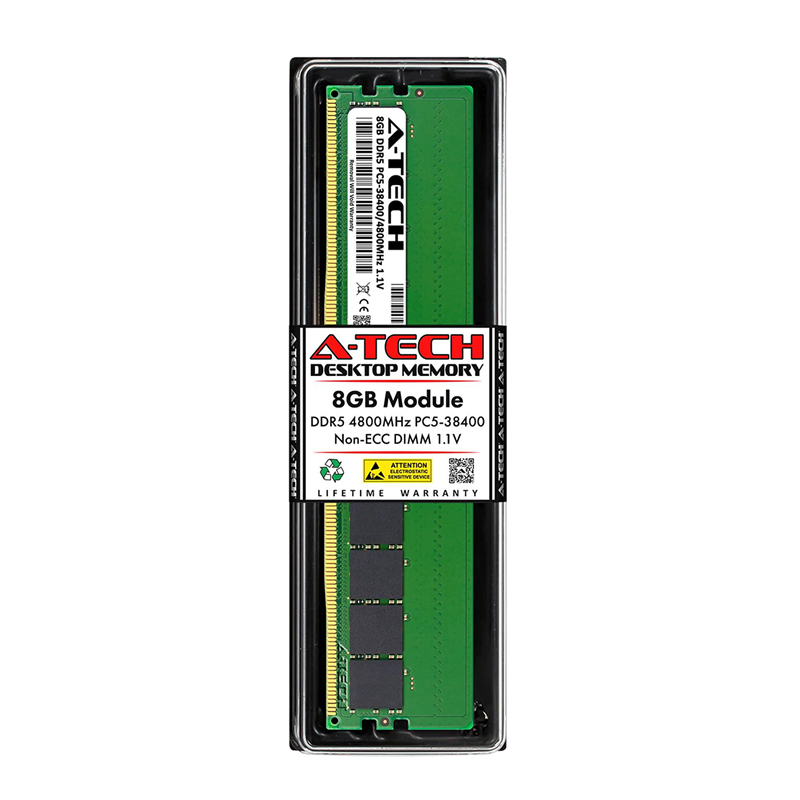
1. Basic Definition and Nomenclature Explanation
PC5-38400 refers to DDR5-4800. It is the initial baseline specification defined by JEDEC for DDR5, and also the default SPD standard frequency for DDR5 platforms out of the factory.
Breakdown of the naming convention:
- PC5: Stands for the fifth-generation double-data-rate memory (DDR5), distinguished from PC4 for DDR4;
- 38400: Theoretical single-channel bandwidth in MB/s. Calculation formula: `4800MT/s × 64bit ÷ 8 = 38400MB/s = 38.4GB/s`;
- 4800MT/s: Data transfer rate, commonly referred to as 4800MHz in the industry. This is not the core clock frequency of memory particles.
>
> This specification is natively supported by Intel 12th Gen Core and AMD AM5 platforms as the default JEDEC standard frequency. It can run at full speed without enabling XMP or EXPO overclocking, delivering the best compatibility among all DDR5 specifications.
2. Core Electrical and Timing Parameters
JEDEC native standard parameters:
- Standard operating voltage: 1.1V (compared to 1.2V for standard DDR4, power consumption reduced by approximately 8%–15%)
- Standard timings: CL40-40-40-77 (CAS latency of 40 cycles). Some manufacturer-optimized versions can achieve CL36/CL38 while maintaining 1.1V
- Bit width: 64-bit single channel; 128-bit dual channel
- Form factors:
- Desktop UDIMM: 288-pin non-buffered Non-ECC;
- Notebook SODIMM: 262-pin;
- Workstation versions support RDIMM ECC
- Capacity options: 8GB/16GB/24GB/32GB/64GB per module, supporting high-density 16Gbit and 24Gbit memory dies
3. Unique DDR5 Architecture Technologies (Fully supported natively by PC5-38400)
1. On-Die ECC
Different from server ECC memory, the On-Die ECC on consumer-grade PC5-38400 is built into the memory die. It automatically corrects read/write errors to improve stability during long-duration operation, suitable for servers, 7×24-hour hosts and industrial PCs. It does not consume CPU memory bandwidth and does not require an ECC-capable motherboard.
>
> Note: On-Die ECC ≠ motherboard-based ECC RDIMM. Ordinary consumer motherboards cannot register ECC RDIMM modules.
2. Dual Sub-channels
DDR5 splits one 64-bit channel into two independent 32-bit sub-channels with separate address and command registers. A single memory module can process two sets of read/write requests in parallel and reduce command queue conflicts. This is the biggest underlying architectural upgrade of DDR5 versus DDR4, and PC5-38400 fully inherits this feature as the baseline specification.
3. On-module PMIC (Power Management IC)
The power management chip is moved from the motherboard onto the memory module. The motherboard only supplies 5V input, and the on-board PMIC regulates the voltage to 1.1V for memory dies. This delivers more precise voltage control, eases motherboard routing constraints, and lays the foundation for high-frequency DDR5 overclocking.
4. SPD-Hub and Programmable SPD
The SPD chip is upgraded to SPD-Hub with larger storage space for configuration profiles. It natively supports XMP 3.0 (Intel) and EXPO (AMD) overclocking profiles. Manufacturers can write multiple overclocking presets into one PC5-38400 module.
4. Performance Profile: Bandwidth, Latency and Comparison with DDR4
PC5-38400 provides 38.4GB/s single-channel bandwidth and 76.8GB/s in dual-channel configuration. Compared with DDR4-3200 (PC4-25600, 51.2GB/s dual-channel), bandwidth is improved by roughly 50%.
In terms of latency: at native CL40 and 4800MT/s, the effective latency is approximately 16.6ns, higher than DDR4-3200 CL16 (≈10ns).
>
> This is a typical characteristic of early DDR5: greatly improved bandwidth accompanied by relatively high baseline latency. Therefore, PC5-38400 offers limited gains over high-speed DDR4 for legacy games and light office workloads. It shines in bandwidth-intensive tasks such as rendering, virtual machines, databases, video editing and bulk file processing.
Recommended scenarios
- New PC builds, servers, soft routers, virtual machine multi-instance deployment, database caching, bulk image and video processing;
- Factory-installed memory for laptops and branded PCs (most factory DDR5 systems ship with PC5-38400);
- Industrial hosts and NAS requiring rock-solid stability without overclocking and continuous 24/7 operation;
- Budget-friendly DDR5 migration, with room for future upgrades to higher-speed memory.
Not ideal for
- Competitive FPS gamers chasing ultra-low latency (DDR5 6000+ with CL30 or lower is preferred).
5. Compatibility Notes
1. Intel: 12th Gen and newer Core processors (LGA1700 / LGA1851). Native support for PC5-38400 with no overclocking required;
2. AMD: AM5 platform (Ryzen 7000 / 8000 / 9000). 4800MT/s is the default SPD speed; higher speeds can be enabled via EXPO;
3. Form-factor incompatibility: 288-pin desktop UDIMM and 262-pin notebook SODIMM cannot be interchanged;
4. Mixed memory configuration: When mixing DDR5 modules of different speeds on one platform, all memory will downclock to the lowest common specification. For example, pairing PC5-38400 with PC5-5600 will run all modules at 4800MT/s.
6. Market Positioning & Selection Guidance
PC5-38400 is the baseline mainstream specification in the DDR5 ecosystem. It has the highest shipment volume, mature die schemes, high yield rates and stable pricing, making it the preferred choice for OEM brand systems.
Two main variants are available on the market:
1. JEDEC native version: Runs strictly at 4800MT/s, 1.1V, CL40, without overclocking profiles. Optimized for stability for servers and branded machines;
2. Retail overclockable version: Retains JEDEC 4800MT/s native settings, while including XMP3.0/EXPO profiles for one-click overclocking to 5600/6000MT/s, balancing compatibility and overclocking potential.
7. Conclusion
PC5-38400 (DDR5-4800) is not the highest-performance DDR5 memory, yet it is the cornerstone of the DDR5 standard. It defines the fundamental architecture, voltage and timing rules for DDR5, balancing compatibility, stability and power consumption. For industrial equipment, servers, office PCs, laptops and bandwidth-heavy multi-tasking workloads, it is a reliable, mature and low-risk option. For gaming users, it can serve as a starting point while higher-frequency DDR5 modules are available for lower-latency performance.