
Samsung PM9D3a: PCIe 5.0 Read-Intensive Data Center SSD for AI and Cloud Infrastructure
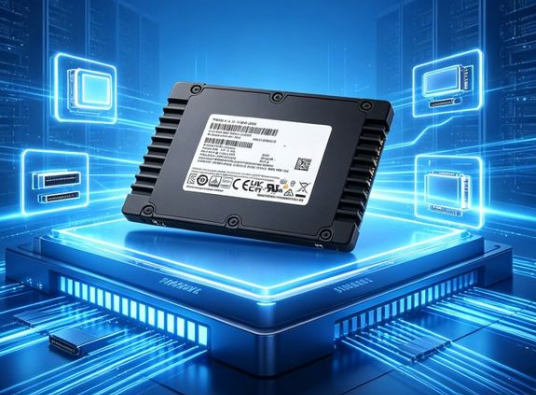
1. Core Hardware Architecture and Specifications
The PM9D3a uses a PCIe 5.0 x4 interface and the NVMe 2.0 protocol, paired with Samsung’s in-house controller and 8th-generation 3-bit TLC V-NAND. Compared with prior-generation V-NAND, it delivers major improvements in cell read stability, read-disturb management and power efficiency, tailored for read-heavy workloads including AI inference, OLTP and content caching.
Key Performance Metrics
- Sequential Read: Up to 12,000 MB/s
- Sequential Write: Up to 6,800 MB/s
- 4K Random Read: Up to 2,000,000 IOPS
- 4K Random Write: Up to 250,000 IOPS
Form Factors and Capacities
Multiple form factors are available for flexible deployment: 2.5” U.2, EDSFF E3.S and E1.S, compatible with high-density racks, blade servers and OCP-standard rack-scale systems. Capacities span 1.92TB, 3.84TB, 7.68TB and 15.36TB; certain OEM variants reach up to 30.72TB.
Endurance is rated at 1 DWPD over 5 years (one full drive write per day for five years). The 15.36TB model offers approximately 14 PBW total bytes written. It targets balanced endurance and read-first use cases, distinct from the high-write-endurance PM1743 series.
2. Core Enterprise-Grade Technologies
2.1 Controller Firmware and V-NAND Machine Learning Management
The PM9D3a integrates a V-NAND ML engine to continuously monitor flash threshold drift, read disturb and data retention characteristics. It dynamically adjusts read reference voltages and garbage collection (GC) policies. It also adopts Fail-In-Place die-level fault tolerance: when a single NAND die encounters a hard error, the drive automatically isolates the faulty die and migrates data without host interruption, preventing full drive outage from a single flash die failure — ideal for large-scale clusters.
2.2 Enhanced PLP and End-to-End Data Path Protection
A tantalum-capacitor array provides Power Loss Protection (PLP). During unexpected power loss, stored capacitor energy flushes all dirty data in the DRAM cache to NAND, protecting both user data and metadata from corruption.
Full end-to-end CRC+ECC validation covers the entire data path from host interface, controller and DRAM cache down to the NAND media. This goes beyond NAND-only ECC to mitigate silent data corruption along transmission paths.
2.3 Security and Standardization
Native AES-256 hardware encryption and TCG Opal 2.0 self-encrypting drive (SED) support are included, alongside secure erase and secure boot. It complies with OCP 2.5 thermal management standards and implements refined thermal throttling logic to control temperature profiles within the compact E3.S form factor, limiting performance degradation under sustained full load. The published MTBF is 2.5 million hours, far exceeding consumer SSDs and meeting continuous-operation requirements in data centers.
3. Workload Fit: Use Cases and Limitations
The PM9D3a is a read-intensive (RI) SSD rather than a write-optimized model. It is commonly deployed in tiered storage alongside Samsung’s PM1743, the high-endurance drive for AI training and checkpoint-heavy write workloads.
Ideal Workloads
1. AI inference: Frontend dataset caching for GPU servers, vector databases and embedding retrieval, sustaining high-bandwidth read streams to feed samples and indexes to GPUs;
2. OLTP/OLAP databases: Hot data partitions and index layers for MySQL, PostgreSQL and ClickHouse with high random read and moderate write activity;
3. CDN, hot object storage cache, log analytics and observability platforms;
4. Virtualization, VDI boot storms and container image registries.
Poorly suited for: Frequent model checkpointing, heavy AI training writes and sustained high-throughput write workloads. For these scenarios, mid-to-high DWPD endurance drives such as the PM1743 are recommended.
4. Comparison with the Predecessor PM9A3 and Peer SSDs
- vs PM9A3 (PCIe 4.0): PCIe 5.0 interface upgrade, ~70% higher sequential read bandwidth, doubled random-read IOPS, identical 1 DWPD endurance and improved power efficiency with lower per-TB power consumption;
- vs Solidigm D7-PS1010: The PM9D3a delivers a higher read performance ceiling and is optimized for inference and database read workloads. The D7-PS1010 has advantages in sequential write and write-heavy tuning. Both share mainstream 1 DWPD endurance and are optimized for different vendor ecosystems.
5. Deployment and Operational Best Practices
1. Form factor selection: E3.S (7.5 mm low-profile) is preferred for high-density rack-scale deployments; U.2 is recommended for traditional rack servers;
2. Capacity planning: The 1 DWPD rating defines a fixed write budget. The drive is highly cost-effective in AI inference clusters dominated by reads. Sustained write oversubscription will accelerate endurance consumption;
3. Firmware: Samsung releases firmware updates to optimize steady-state performance and background GC scheduling. Uniform firmware revision is strongly recommended across large fleets;
4. Monitoring: NVMe-MI, SMART and telemetry data are exposed for integration with Prometheus and server BMCs, enabling tracking of media errors, temperature, remaining endurance and PLP capacitor health.
6. Conclusion
The PM9D3a (PM9D3) is Samsung’s general-purpose read-intensive flagship SSD for the PCIe 5.0 era. Rather than prioritizing extreme write endurance, it is architected to maximize read bandwidth, random-read performance, standardized high-density packaging and fault tolerance for large-scale clusters. Within modern AI tiered storage architectures, it functions as the inference, hot-database and caching layer. Paired with HDD cold storage and high-endurance SSDs for training workloads, it forms a complete storage stack and represents a mainstream PCIe 5.0 SSD option standardized by major cloud providers.