
The AI PC Wave Has Arrived: How Do We Break the Local AI Storage Bottleneck? The Samsung 9100 PRO Delivers the Definitive Answer
In 2026, the AI PC has fully moved beyond its concept-priming phase and entered the mass consumer market. As local large models iterate rapidly, AI agents run on a permanent basis, and AIGC creation becomes mainstream, the performance center of gravity in PC hardware is quietly shifting. In the past, people focused only on processor and graphics card performance; today, storage has become the core weak link that determines the local AI experience.
Unlike the basic storage demands of traditional office and entertainment scenarios, running local AI places extreme requirements on a drive's read/write speed, random response, stability, and capacity. Whether you are deploying a local large model with billions of parameters, running an AI agent 7×24, or efficiently finishing AI painting and video generation work, a high-performance flagship SSD is the last and most critical link in unlocking the complete AI PC experience.
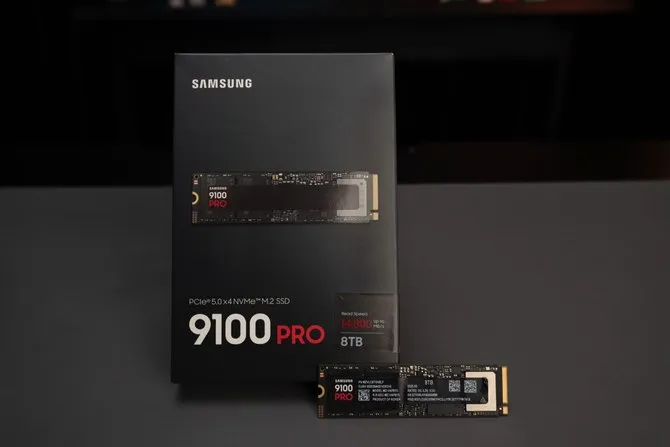
As a benchmark flagship among PCIe 5.0 SSDs, the Samsung 9100 PRO remains firmly in the top tier of high-end storage. With local AI demand growing explosively, why does it continue to lead? This article breaks down the flagship SSD's hardcore capabilities across three dimensions: its core hardware foundation, its measured performance, and its full-scenario AI adaptability.
1. Fully In-House Core Hardware: Laying a Sturdy Storage Foundation for the AI Era
A flagship product's core competitiveness is always hidden in its underlying hardware architecture. The Samsung 9100 PRO carries a complete in-house Samsung hardware solution, guaranteeing a high-performance, low-latency, AI-dedicated storage experience from the ground up, with base specifications pushed to the top: a 5nm in-house controller, 8th-generation V-NAND TLC flash memory, dedicated DRAM cache across the entire lineup with capacity-matched low-power DDR4X cache, paired with PCIe 5.0 x4 and the full-bandwidth NVMe 2.0 protocol — today's top-tier configuration in consumer storage.
Compared with the previous-generation PCIe 4.0 flagship 990 PRO, the Samsung 9100 PRO achieves across-the-board performance doubling. Its leap-forward sequential read/write capability compresses the transfer of dozens of GB of HD assets and large-model weight files down to seconds, thoroughly solving the common pain point of traditional SSDs — "long stalls and waiting when loading large models."
Even better suited to AI scenarios is its dramatically upgraded random performance, reaching up to 2200K/2600K IOPS. The defining characteristic of local AI workloads is high-frequency read/write and real-time scheduling of massive amounts of fragmented data; model inference, vector retrieval, background agent computation and similar operations all depend heavily on a drive's random response speed. The top-tier random I/O capability of the Samsung 9100 PRO effectively reduces data latency, providing stable, efficient underlying support for all kinds of local AI tasks.
Two details are worth attention when buying: the 8TB high-capacity version uses a double-sided NAND layout, so it differs in thickness and weight from the standard-capacity versions — confirm your case and motherboard mounting space before assembly. In addition, Samsung offers a version of this drive with a factory heatsink, suited to mainstream builds, which can be purchased directly to save the trouble of adding cooling later.
2. Measured Full-Capacity Release: Performance and Thermal Control Both On Point
To show the Samsung 9100 PRO's true strength directly, we built a full-spec test platform: an AMD Ryzen 7 9800X3D processor and an MSI X870E CARBON motherboard, with the drive installed in the motherboard's CPU-direct PCIe 5.0 x4 full-speed slot. We selected the 8TB version and completed the full benchmark suite, with authentic and referenceable results.
CrystalDiskMark empty-drive test: sequential read 14846.95 MB/s, sequential write 13414.25 MB/s; 4K random read 2073.304 KIOPS, 4K random write 1842.168 KIOPS. The measured data matches the official specifications closely — no inflated figures, no performance shrinkage — delivering the full-strength PCIe 5.0 flagship capability.
【Image: CrystalDiskMark empty-drive test screenshot】
PCMark 10 system drive benchmark: overall bandwidth 1044.02 MB/s, average access time as low as 24μs, overall score 6753. Across the entire PCIe 5.0 SSD product line, this result sits firmly in the top tier; as a system drive it handles everyday office work, high-performance computing, and AI workloads across the board.
【Image: PCMark 10 test result screenshot】
Long-duration thermal performance: after multiple rounds of continuous full-load testing, CrystalDiskInfo monitoring shows a maximum drive temperature of only 66°C. Compared with the common flaw of early PCIe 5.0 SSDs — "high speed inevitably means high heat, and full load inevitably means throttling" — the Samsung 9100 PRO, through its 5nm low-power controller and precisely tuned in-house flash, achieves a balance between high performance and excellent power efficiency. It holds temperature steadily even under long, high-load AI operation, eliminating throttling and stutter.
【Image: CrystalDiskInfo long-duration monitoring data】
The overall test conclusion is clear: the Samsung 9100 PRO releases its performance completely, delivers rock-solid stability, and shows excellent thermal control, thoroughly solving the power and thermal shortcomings of the previous generation and of comparable flagship SSDs, and laying a solid foundation for long periods of high-load AI operation.
3. Precisely Adapted to Local AI Scenarios, Solving Core Usage Pain Points
For ordinary users, a drive's speed is merely a difference in transfer time; but for local AI enthusiasts, AIGC creators, and AI agent aficionados, storage performance directly determines "whether it can run, and whether it runs smoothly." Consumer graphics cards have an inherent VRAM ceiling — even the top-spec RTX 5090 has only 24GB — so VRAM overflow is easy to hit with large-parameter models. The core value of the Samsung 9100 PRO is precisely that its formidable storage performance compensates for the VRAM and memory shortfalls.
Scenario 1: Local large model deployment — no more loading stalls or interrupted inference
When deploying a local large model, loading tens of GB of weight files and performing real-time model inference are the segments that test storage the hardest. Traditional SSDs have limited read/write speed: not only does model loading require a long wait, but once VRAM overflows and the system uses virtual memory Swap scheduling, severe inference stutter and frame freezes appear.
The ultra-high bandwidth of the Samsung 9100 PRO greatly accelerates the flow of model data from drive to memory, shortening load times. More critically, its top-tier random IOPS performance can effectively absorb the high-frequency data scheduling that follows VRAM overflow, minimizing performance loss and keeping model inference coherent and smooth. Even users on mainstream mid-range graphics cards with 12GB or 16GB of VRAM can run all kinds of local large models smoothly thanks to a "VRAM + memory + high-speed SSD" tiered storage architecture, substantially lowering the hardware barrier to local AI deployment.
Scenario 2: AI agents running permanently — stable 7×24 response
The currently booming OpenClaw AI agent ("lobster agent") use case places extremely high demands on a drive's random read/write capability. During 7×24 permanent operation, the agent continuously generates fragmented read/write operations: calling various Skill plugins in real time, executing automation scripts, and recording run logs, while also relying on the RAG long-term memory mechanism to repeatedly retrieve local knowledge bases and historical conversation data.
【Image: OpenClaw local workspace screenshot】
With insufficient random response speed on an ordinary SSD, task queuing, response delays, and logic interruptions occur easily. The Samsung 9100 PRO, with its top-tier 2200K IOPS random read performance, handles multi-agent concurrent task scenarios with ease, eliminating task interruptions caused by I/O congestion. At the same time, it compresses RAG knowledge base retrieval time to the millisecond level, making AI agent feedback more timely and operation more stable.
Scenario 3: AIGC creation acceleration — storage no longer drags on the creative rhythm
In AI painting, AI video generation and other creative scenarios, the efficiency of asset loading, model invocation, and final output export directly affects the creative rhythm. Large high-definition assets and high-precision AI model files are enormous in size, and the read/write shortcomings of ordinary SSDs seriously slow the creative workflow.
The full-capacity read/write performance of the Samsung 9100 PRO easily handles the read, write, and export demands of all kinds of large AI assets and high-precision models, with no stutter and no delay throughout, keeping the creative flow coherent and smooth. At the same time, the 8TB ultra-large capacity version can store over a hundred AI models of different styles and a vast library of assets in one go, with no need to frequently delete and swap files — letting creators focus on inspiration and the work itself, free from capacity anxiety.
4. A Balance of Security and Ease of Use, Suited to Long-Term High-Load AI Use
Local AI operation is mostly a long-duration, high-load workload, and it involves large amounts of private conversation data, proprietary knowledge bases, and original creative assets, placing dual demands on a drive's stability and data security. Beyond its hardcore performance, the Samsung 9100 PRO also maxes out the finer details of the experience.
On the security side, the drive supports AES 256-bit hardware-level encryption, protecting local AI private data, original assets, and private knowledge bases from the hardware level up, effectively averting the risk of data leakage. On the ease-of-use side, paired with the dedicated Samsung Magician management software, users can complete drive health monitoring, firmware updates, performance tuning, and data migration with one click through a visual interface. Even beginners can get started easily, greatly lowering the barrier to using and maintaining a high-end SSD.
【Image: Samsung Magician desktop software interface】
5. Conclusion: In the New AI Era, Storage Is Core Productivity
As local AI becomes fully mainstream, the criteria for judging PC performance have been restructured. The processor determines computing speed, the graphics card determines rendering efficiency, and storage determines the ceiling of the local AI experience. Model loading speed, agent response efficiency, and AIGC creation smoothness — every core experience ultimately depends on drive performance.
With its full-capacity sequential read/write at the 14800MB/s level, top-tier 2200K/2600K IOPS random performance, excellent thermal stability, and ultra-large capacity specifications, the Samsung 9100 PRO precisely solves the storage pain points of the three core scenarios — local large model deployment, AI agent operation, and AIGC creation — making it the benchmark product among today's consumer PCIe 5.0 SSDs.
From a market perspective, storage industry prices are rising overall at present; compared with aging PCIe 4.0 and PCIe 3.0 SSDs, the value proposition of a full-capacity PCIe 5.0 flagship is in fact becoming more prominent. The Samsung 9100 PRO comes in 1TB, 2TB, 4TB, and 8TB capacity tiers, covering entry-level AI users, professional creators, and deep enthusiasts alike. In an era of full AI PC adoption, this flagship SSD — balancing performance, stability, capacity, and security — will continue to lead the local AI storage race for a long time to come.